



How Lady Gaga’s ‘Wednesday’ Costume Used Bird Feathers and Silk Embroidery to Dress the Ghostly Rosaline Rotwood


by Jazz Tangcay-Sep 3, 2025
SPOILER ALERT: This story contains spoilers for Season 2, Part 2 of “Wednesday,” now streaming on Netflix.
The previous Halloween, Colleen Atwood, the Oscar-winning costume designer, stood on stage at SCAD Savannah Fest, accepting Variety’s Creative Impact Award. The moment the applause faded, she was off—racing back to Los Angeles for a secretive VIP fitting, one cloaked in mystery and tied to the enigmatic world of “Wednesday.”
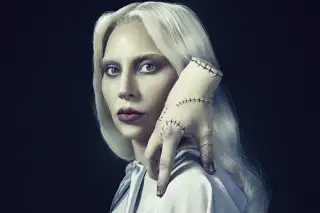
That fitting, as it turned out, was for none other than Lady Gaga—whose haunting cameo in Episode 6, “Woe Thyself,” brought the spectral figure of Rosaline Rotwood to life. In the series, she appears as a ghostly remnant of Nevermore’s past, a teacher long gone but never truly forgotten.
One fateful night, Jenna Ortega’s Wednesday follows the cryptic wisdom of her grandmother, Grandmama Hester Frump (played by the inimitable Joanna Lumley), in search of a deeper psychic connection. Standing before Rosaline’s tomb, she deciphers the inscription and, in doing so, is drawn into the grave itself—where she comes face to face with the ethereal presence of the long-departed educator.
For this otherworldly character, Atwood selected a fabric that whispered of the past: a “putty gray French wool crepe.” But the true artistry lay in the subtleties. “It was adorned with silk embroidery of feathers,” she reveals, each stitch a whisper of Rotwood’s tragic legacy.
Colleen Atwood, a constant presence across both seasons of the show, drew inspiration from the character’s lore. “The story placed her death in the 1930s,” she explains, “and that era became the heartbeat of her look.” The raven—a recurring symbol in the series—also found its way into the design. “Rosaline had a birdlike essence, so we wove feathers into her dress, like whispers from beyond.”
Originally, the vision was even more dramatic—“sharp, pointed shoulders, like a bird hunched in mid-flight.” But the physical demands of the scene led to a more subtle approach. Still, the spirit of wings remained, embodied in the sweeping sleeves that echoed the silhouette of a ghostly raven in motion.
Atwood’s love for crepeline, a delicate silk, led to an inspired moment during the fitting. “I suggested placing it over her head—it would flutter, ghost-like, while still revealing the gray beneath. She adored the idea.”
Beyond Gaga’s spectral presence, Atwood revisited the iconic Morticia Addams (played by Catherine Zeta-Jones), reimagining her look to suit the family’s evolving world. Now stationed at Nevermore Academy, Morticia takes on a new role as a fundraiser. Production designer Mark Scruton introduced red into the sets, and Atwood followed suit, weaving crimson accents into Morticia’s wardrobe—a subtle nod to her gothic elegance, now stepping into unfamiliar light.
Zeta-Jones embraced the evolution wholeheartedly. “We had a lot of opportunities with Catherine to take Morticia beyond the shadows of the family mansion, while still honoring the silhouette that made her unforgettable,” Atwood reflects.
Where jersey once draped Morticia’s form, this time Atwood chose a “thin stretch velvet.” Though not an extravagant fabric, it captured the light beautifully—richer than jersey, with a subtle weight that gave Morticia a presence both grounded and otherworldly.
One of Atwood’s favorite characters to design for was Grandmama Frump. In a particularly memorable scene, she and Wednesday go hunting, and Grandmama’s bold hunting jacket becomes a statement of both style and function.
“It was inspired by a Schiaparelli piece from the 1930s,” Atwood recalls. “The pockets were embroidered with silver bullion—strong enough to hold bullets, yet elegant enough to maintain the silhouette. She could shoot and still look regal.”
Grandmama’s signature look also featured a dramatic collar that fanned out like a gothic flourish. “As an Addams, her palette remained black, accented with whispers of white and gray. That collar—so sharp, so theatrical—really spoke to her character. And in a way, it echoed the shape of Gaga’s dress, as if both women, though separated by time and death, were part of the same haunting legacy.”