



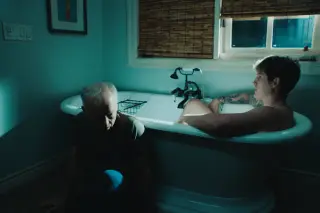
For those viewers who think that the title "Blue Film" that would be a lust teasing, they may feel a little disappointed.Indeed, the word "Blue" implies sex in the film, and this is one of the core issues constructed by the screenwriter and director Elliot Tuttle.In this thought-provoking double play, a middle-aged teacher from Maine and his former student, now a sex worker in Los Angeles, reunited in a unique rental house and spent an unspeakable peaceful night.However, what this relationship touches on are emotional desires that are hard to speak and not desire.As the two gradually uncovered the silence of the past and faced the confusion of the present, the audience felt more of a depressed and nervous mood: the old taboos and power imbalance are still in lingering.
"Blue Film", premiered in the main competition unit of Edinburgh Film Festival, is a work that does not hide its provocative meaning, but it is by no means empty.The two protagonists in the film - one is a former teacher who was imprisoned for childbearing, and the other is an online performer full of masculinity and special hobbies as the selling point - do not easily arouse people's simple sympathy.But luckily, Tuttle is more concerned with understanding them, showing their psychological trauma in detail, and giving the right to judge to the audience.The wonderful performances of Tony Award winner Reed Birney ("Mass") and British new generation actor Kieron Moore do not shy away from the hard, complex and even uncomfortable human aspects of the character's personality.This sketch-style work with strong emotional tension is worthy of the attention of publishers who pursue pioneering style and LGBTQ themes, and is expected to continue to shine at major film festivals in the future.
Within the opening minutes of the film, we were completely controlled by Alex (Moore) — or should he be called Aaron Eagle, his stage name in the fan circle.Under the camera, he had just finished a fitness training, his muscles were tight and arrogant. He was performing a live online performance with SM elements, teasing the audience with insulting language, but he also received a lot of rewards for this.On the other end of the screen, Hank (Birney), a stranger wearing a balaclava hood and a gentle tone.He offered a bolder offer: $50,000 for a night of spending time together.Alex accepted it.
When Alex arrived at the suburban house rented by Hank, he was confident that the older man was nothing more than another client who wanted to experience "sports-type humiliation."But soon, Hank's hidden face and quiet but inquiry existence made him feel uneasy.As someone who is used to acting in front of the camera, Alex is no stranger to things like shooting dialogues, especially when the topic revolves around "first sexual experiences", it reminds people of Soderbergh's "Sex, Lies and Video Tapes".However, when Hank reveals that he knows Alex's real name and hometown, the situation reverses instantly.
The mask is taken off, both physically and psychologically.Alex recognized Hank in front of him as Mr. Grant, his middle school teacher, who was fired, arrested and jailed for trying to sexually assault a boy.Although Alex was not a direct victim, he was also the object of Hank's desire.Now, he is an understatement of this as a living by relying on his body, and this attitude caught Hank off guard.So a fragile and delicate tug-of-war begins.During this long night, the two kept testing each other's bottom line, memories and lies intertwined, desires were analyzed rationally or faced with sensibility, and the possibility of legal but still full of taboos is always hanging in the air.
This is a work that is inevitably mainly dialogue, and it may be more dramatic if it is put on the stage.However, Tuttle and editor Zach Clark (who is himself a director who specializes in low-cost independent films) have successfully kept the conversation between the pair tense and propulsive, although the cycle of thought is slightly repetitive as the film comes to an end.Photography director Ryan Jackson-Healy draws inspiration from the title, using late-night blue-green light and shadows to create an uncomfortable atmosphere that is unpleasant but cannot be seen away, and cleverly switches the clear digital images and the grainy video texture that Alex is familiar with.
Birney interprets the role of Hank in a restrained but not deliberately beautification.He showed the character's inner sorrow and unsatisfied desire without any hesitation, and at the same time he also had a faint sense of self-knowledge - as if he had accepted that his desire would never be able to rest.For Moore, "Blue Film" is his first major debut on the big screen. He has previously participated in series such as "Sex Education", "Air War Heroes" and "Vampire Academy".With his extremely physically expressive performance, he perfectly presented a young man who was used to becoming the focus of everyone: he was arrogant on the outside but was fragile on the inside. Once no one was watching, he quickly returned to the uncertain and need to be understood boy.