



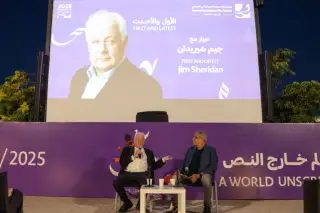
The famous Irish director Jim Sheridan was honored at this Amman International Film Festival, and Ireland also participated in the grand event as an honorary country.
The six-time Oscar-nominated director (representative works "My Left Foot" and "In the Name of Father") not only debuted with a brand new project, but also talked about his views on the current situation of the film and the role of politics in the narrative.
A work that Sheridan is preparing for is quite innovative - a film about the Galapagos sea lion "The Lion of the Ocean".He smiled and said, "It's a fictional work, but the protagonist is a real sea lion. Doesn't it sound like a little crazy?" The film revolves around a male sea lion leader who must survive in a world that is unbalanced by overfishing and climate change.“The world has lost its balance and they don’t know how to deal with it.”
In addition, he also co-developed a more personal work with his daughter Clodagh, tentatively titled Into and Out of Africa.The inspiration was from the real journey of the two of them driving from Dublin to Marrakech, with two cats and a dog on the way."This work combines immigration stories with family stories," he said, "just like "In the Country of America", but this time they are going to Africa, not the United States." The film tells the story of a father and daughter traveling across national boundaries and culture, gradually deepening their understanding of each other while accompanying each other.
During her time in Amman, Sheridan reviewed how Ireland’s complex history shapes its cinematic language and influenced its attitude toward global issues.“We have collective memory of oppression,” he said of Ireland’s colonial history, “so it’s easier for us to understand those who resist the oppressive structure.” He notes that this emotion has shaped Ireland’s way of expressing solidarity in recent years, although he tends to focus on historical analogies rather than current political controversy.
His works have long focused on topics such as identity, trauma and injustice.When asked about the resonance of these topics in the Middle East, he compared them to other regions that have experienced colonial history.“The situation in the Middle East is much worse than what Northern Ireland once faced,” he said, “but I think the only weapons available are thought and nonviolence. The forces of peace are difficult to organize, but that is exactly what we need.”
Sheridan emphasized that the key to storytelling is to connect the audience with the individual, rather than falling into abstract political concepts.“It’s very difficult to find a true individual hero in a collective situation,” he admitted. “In a place like Gaza, it’s very challenging to present a rich and diverse story of characters without making them a symbol on the headlines. You want to give the group a human face, but this path is not easy.”
This kind of struggle is no stranger to him.In creating "In the Name of Father", he chose to focus on the relationship between a pair of fathers and sons who were wrongly convicted, rather than the macro context of the entire "Guilford Four Case".“The father and son are in jail, this is the movie, it is the story of the individual,” he said. “A nonviolent father with an image of moral authority, and this power cannot be refuted.”
Sheridan believes that films today are gradually losing their moral core, and, worse, that spirit of collective sharing."In the past, movies were part of TV. When you see trailers on TV, you would want to go to the cinema. Now, TV tells you: Don't go out, just stay home." He said slightly sarcastically.He is skeptical of the influence of streaming platforms on the art of film.“The collective movie-watching experience has gone,” he said, “they are making bad movies. I haven’t seen a really good movie on streaming yet.” His tone was as straightforward as ever.
Despite this, Sheridan still has expectations for emerging voices.“Irish films are now coming to a wave of success,” he said of the recent well-received “The Quiet Girl” and “The Banshee of Innisherin”."But I want to see more politically conscious works. There are not enough 'propaganda' artwork. I'm tired of entertainment. Americans play entertainment better than anyone else. We need different voices."
During the Amman Film Festival, Sheridan had in-depth exchanges with filmmakers from all over the Middle East.“I met not only Jordanians, but also friends from Egypt, Palestine and other places,” he said."Jordan is like a country with open borders, and there seems to be no strong xenophobia. It has a nomadic cultural temperament that tolerate outsiders."
Looking to the future, Sheridan is fully committed to the script conception of "Traveling Africa".At the same time, he also firmly hopes to reawaken the audience's love for the collective movie viewing experience.“I’m eager to bring that shared viewing atmosphere back to the theater,” he said, “and I’ll try to do it.”