



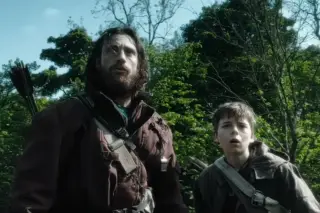
When the first teaser for "28 Years Later," the third chapter in Danny Boyle and Alex Garland’s iconic horror saga, arrived, its visceral imagery of a dystopian world overrun by zombies was enough to send shivers down anyone's spine.
Yet what elevates this trailer from merely unsettling to deeply haunting is the chilling rhythmic chant that underpins it. A high-pitched, nasal voice delivers the chant with military precision, monotonal at first but gradually crescendoing into an increasingly frantic cadence. As the visuals and accompanying score accelerate in intensity, the auditory experience becomes almost unbearable—an aural embodiment of dread.
In this context, even though the lyrics seem disconnected from the apocalyptic scenes on screen, their effect is nothing short of harrowing. The chant feels like a deranged rap song, its repetition drilling itself into your psyche, amplifying the ominous tone of the film.
This haunting incantation turns out to be "Boots," a poem by Rudyard Kipling originally published in 1903. Intended to capture the maddening monotony of soldiers marching during wartime, it draws inspiration from the grueling marches endured by British troops across southern Africa during the Second Boer War, according to the Kipling Society.
The version used in the film dates back nearly as far as the poem itself, recorded in 1915 by actor Taylor Holmes. His dramatic reading begins with militaristic formality, setting the scene with precise diction. However, by the end, his voice spirals into hysteria while maintaining the relentless rhythm:
"I—have—marched—six—weeks in hell and certify
It—is—not—fire—devils, dark, or anything,
But boots—boots—boots—boots—movin’ up and down again,
And there’s no discharge in the war!
Try—try—try—try—to think of something different
Oh—my—God—keep—me from going lunatic!"
Over time, "Boots" has served as a marching anthem for various armies worldwide. Its psychological impact is so potent that the U.S. military incorporated it into SERE (Survival, Evasion, Resistance, and Escape) training programs.
Despite its prominence in the trailer, the poem plays only a minor yet foreboding role in the actual film. Accompanied by an eerie bass synthesizer, it underscores Spike and his father's journey toward the mainland—a place teeming with infected zombies—and metaphorically suggests they are marching into battle.
One might wonder why Boyle chose a 110-year-old recording tied to the height of the British Empire to convey such a message. In an interview with Variety, he offered insight:
“We had access to numerous archives we wanted to use to reflect the culture being instilled in the island's children,” Boyle explained. “This was very much a regressive approach—they were yearning for a time when England was perceived as great.”
He drew parallels between Kipling's work and Shakespeare: “For those familiar with 'Henry V,' there's the famous Saint Crispin's Day speech celebrating noble English triumph over the French with bows and arrows. We initially considered using that speech but decided against it—it felt too obvious.”
Boyle recounted how the decision crystallized after viewing Sony's initial trailer: “Alex and I vividly remember watching it, and when this [recording] came on, we were both struck speechless. It possessed an uncanny power."
David Fruchbom, Sony's EVP of global creative advertising, revealed the origin story behind the inclusion. Megan Barbour, then director of music at Buddha Jones, suggested the track based on her knowledge of SERE training participants who encountered it. She forwarded it to trailer editor Bill Neil, who embraced the idea. “We aimed to leverage the strength of the visuals without overwhelming them with dialogue,” Fruchbom noted. Among three proposed teasers, the one featuring "Boots" stood out decisively.
Its effectiveness was undeniable, prompting Boyle to swiftly integrate it into the final cut. “It’s almost like reverse osmosis,” he remarked. “Once it entered the film, it seemed to clarify so much of what we'd been striving to achieve.”
Boyle also marveled at the enduring resonance of Kipling's words and Holmes' performance: “You have to pause and ask yourself, ‘How can something recorded over a century ago retain its visceral power today?’ Even in our TikTok-driven world, it remains astonishingly impactful. That's truly remarkable.”
Additional reporting by Bill Earl.