



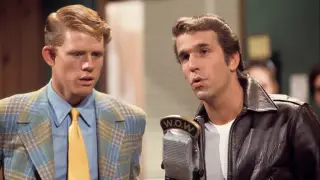
Ron Howard has been a beacon of success in Hollywood for nearly five decades, yet the project most people associate with him remains the beloved sitcom "Happy Days." Spanning 11 seasons from 1974 to 1984, this ABC series was where Howard first made his mark as Richie Cunningham, a role that became synonymous with his early career. While it might seem surprising that Howard never directed an episode of "Happy Days" himself, the show played a pivotal role in shaping his trajectory as a filmmaker. It was during these years that he began experimenting with short films, laying the groundwork for what would become a storied directing career.
Henry Winkler, who portrayed the iconic Arthur Fonzarelli (the Fonz), was instrumental in Howard's transition from actor to director. Their on-screen camaraderie extended beyond the set, with Winkler supporting Howard's aspirations wholeheartedly. In fact, when Winkler agreed to star alongside Howard in Night Shift (1982), it secured the film’s greenlight—a testament to their enduring professional bond. Speaking recently to EW, Howard reflected, "Henry was always so supportive of that. When Henry said yes to 'Night Shift,' that's what got that movie greenlit."
By stepping away from Fonzie's leather jacket and catchphrases to take on the more grounded role of Chuck Lumley in Night Shift, Winkler helped Howard realize his dream of becoming a studio director. This marked the beginning of a flourishing career that would see Howard helm critically acclaimed films like Apollo 13, A Beautiful Mind, and Frost/Nixon. Even today, Howard fondly acknowledges Winkler's contribution: "He played a hand in helping my dream ultimately come true."
Howard departed "Happy Days" after its seventh season to focus on his burgeoning directing career. Following the triumph of Night Shift, he went on to direct comedies such as Splash and Cocoon, before reuniting with Michael Keaton for Gung Ho in 1986. His collaboration with Keaton began on Night Shift, marking the Batman actor's breakout feature film role.
After establishing himself as a comedic director, Howard ventured into high fantasy with Willow in 1988. Produced under George Lucas' executive guidance, the film introduced Warwick Davis to audiences worldwide and featured Val Kilmer in a starring role—another future Batman. Since then, Howard has continued to push creative boundaries, delivering masterpieces that resonate deeply with viewers across generations.
In 2018, Howard stepped into the Star Wars universe with Solo: A Star Wars Story. Though the film received mixed reviews, it established a family legacy within the franchise. His daughter, Bryce Dallas Howard, also an accomplished actor and director, joined the Disney series The Mandalorian as a director in 2019, contributing her talents to every season of the hit show.
Recently, Howard embraced a playful subversion of his public persona in Seth Rogen's Apple TV comedy The Studio. Playing a fictionalized version of himself, Howard challenged the "nice guy" image cultivated by his time on "Happy Days." As part of this satirical exploration of Hollywood culture, the character depicted in The Studio offered a refreshingly candid look at the complexities behind one of cinema's most respected figures.